
 The society’s lecture series continued on 15 March with an entertaining session led by Euan Macpherson on the theme of ‘Scotland’s Forgotten Heroes.’
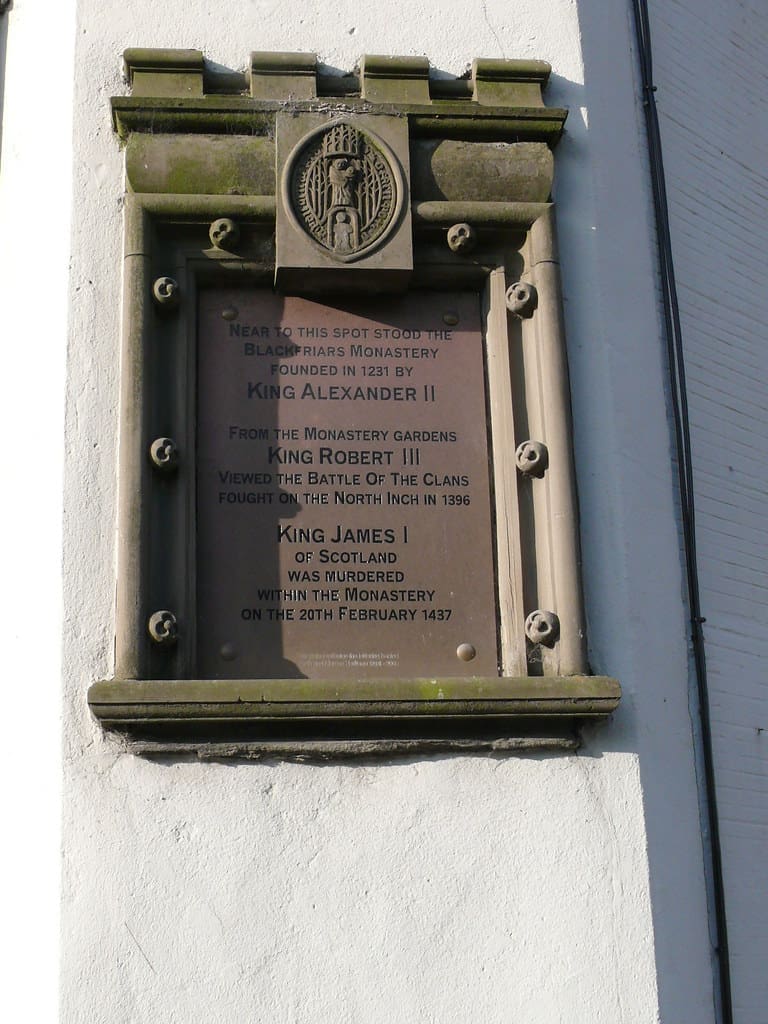
Euan began by drawing our attention to an obscure plaque in Perth which commemorates no fewer than three of our kings: Alexander II, who established the Blackfriars monastery near the site; Robert III, who presided over the notrious, gladiatorial ‘Battle of the Clans,’ fought on the North Inch in 1396; and James I, murdered at the monastery in 1437. It is scarcely a fitting monument, Euan argues, to three kings of Scots, two of whom have no known memorial elsewhere. Indeed, with the exception of Robert the Bruce, who has statues in the Royal castles of Edinburgh and Stirling and in Marischal Square in Aberdeen, whose Royal Charter he granted, there is hardly a single public monument to any King of Scots.
In the majority of cases, even their burial places are unknown, or at least obscure. The last Royal burial on Iona took place in 1099 and subsequent sovereigns were mainly buried in one of the great monastic institutions, mainly in the abbey of Dunfermline, where the Scots kings had their principal palace, which were comprehensively destroyed in the post-Reformation turmoil of the later 16th century. Consequently, few of their tombs have survived and there has since been little appetite to raise memorials for them elsewhere.
That pattern is reflected across the rest of Scottish history. So many of the great, influential or heroic figures of our past are entirely forgotten today, often supplanted by semi-mythical figures of whose real lives little is known and who are largely creations of later writers, driven by political or cultural motives.
 Among those cited was Sir Andrew Moray, who shared command at the iconic Battle of Stirling Bridge with William Wallace. There is a school of thought which suggests that Moray was a far more experienced commander than Wallace, who would in all likelihood have lacked the training and experience of first rank battles to achieve a such a stunning and unexpected victory in an engagement of that sophistication. However Moray was mortally wounded in the combat, although he did not die for several months, whereas Wallace went on to become a Titanic figure in Scotland’s struggle to throw off English domination, immortalised in Blind Harry the Minstrel’s epic poem, written 150 years after his death. Very little is known of Wallace’s career as a matter of certain fact, and Euan’s suggestion is that he has attracted a semi-mythical status with many of his exploits misattributed, either wholly or in part.
A further example cited was that of Katherine Douglas, the famous ‘Kate Barlass’ who is recalled for her doomed attempt to save James I’s life on the occasion of his murder at Perth’s Blackfriars Monastery, who is the subject of Euan’s latest novel, A Dagger for Katherine Douglas. She attempted to keep his murderes at bay by inserting her arm into the brackets of his bedchamber door, resulting in horrific injuries and, possibly, her death. But she too is now a largely unknown figure, her heroism more or less forgotten. Although clearly someone of some prominence, as a lady in waiting to James I’s queen, it is not known what became of her. We don’t even know with any certainty to which branch of the extensive Douglas kindred she belonged.
Euan’s rather depressing conclusion is that culturally we are really only interested in heroes whose deeds stir the blood by virtue of their success. Heroic failures are destined to remain forever in the shadows.