
 The society is very grateful to Dr Bob Irving, who joined us via Zoom on 20 April from his native Australia to lead a lecture and lively discussion on the ship of the Spanish Armada, which mysteriously blew up off the coast of Mull in 1588.
Bob is a molecular biologist by profession, but he has long been involved in a wide variety of heritage projects in the west of Scotland. He managed the Kilbryde kirkyard survey and assisted with the Lochbrow Landscape Project. He is a volunteer with the Inveraray Castle archives and the Mull Museum, both of which house much of the surviving material on the Tobermory wreck.
The ship now lying in Tobermory Bay was long believed to be the Florencia, carrying a large amout of gold intended to pay the army of the Armada, and greed for that gold is advanced as a possible motive for her destruction. The story of the galleon continues to generate interest, nearly 500 years after the fact, and is being kept alive with its retelling by schoolchildren on the island, some of whose imaginative drawings Bob used to illustrate his lecture.
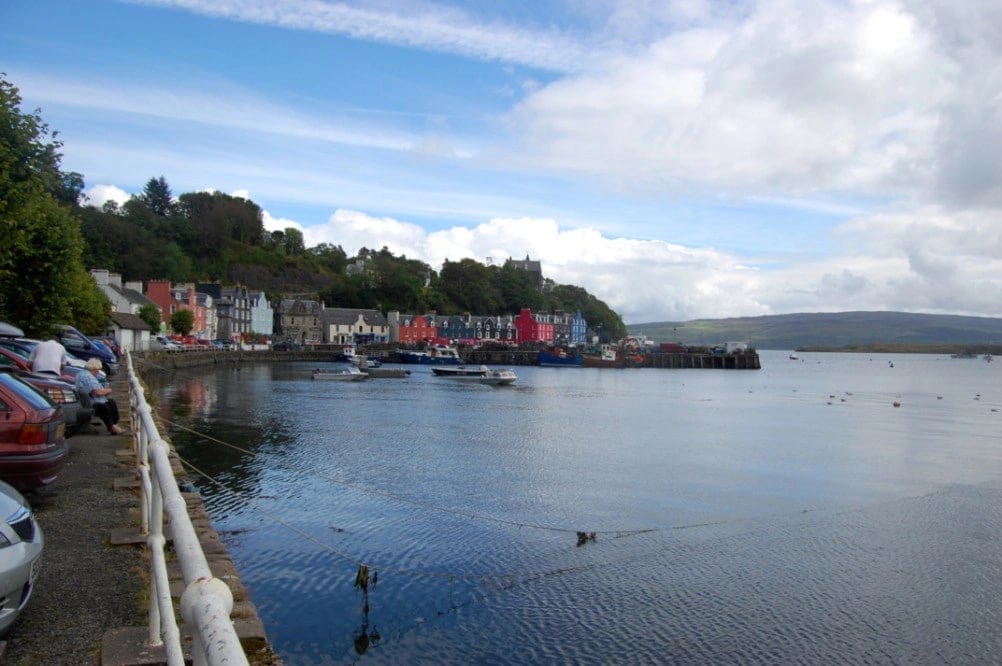 Following the Armada’s defeat, the ship was one of several that headed for the realtive safety of Scotland and it put into Tobermory in September 1588 for supplies, fresh water and repairs. On attempting to leave the island, it exploded in the bay, 300 metres from what is now the New Pier. Attempts at salvage began early and continued throughout the 17th century and beyond. Subsequent archaeological work suggests the ship is not the Florencia, but the San Juan de Sicilia, and this identification is now generally accepted, even though it is not listed as a ship of the Armada. The San Juan was a ship of Ragusa (modern day Dubrovnik) and was comandeered by Spain in 1588, it is believed for the bulk transport of siege artillery and invasion stores. Whilst in Tobermory, she is recorded as carrying 26 guns, 63 seamen, and 279 soldiers.
There are several theories behind her destruction, of which the most mundane – that the powder on board detonated by misfortune or simple human error – is regarded as the least likely. One is that she was destroyed on the orders of Maclean of Duart’s wife, motivated by the attention her husband paid to a beautiful Spanish princess said to be on board, for whom he had formed a passion. Lady Maclean apparently turned to the Blue Eyed Witch of Lochaber, who conjured up a pack of fairy cats to terrorise the Spanish crew. One of the cats chased a terrified sailor into the powder magazine, where it was detonated by sparks from her tail.
More prosaic explanations include the suggestion that the ship’s destruction was contrived by John Smollett, a burgess of Dumbarton who was also an English agent, to discourage further use of Mull as a springboard from which Spain could threaten England, or that Maclean of Duart himself was responsible, motivated by greed for the gold she was said to carry.
The answer will likely never be known but the story continues to fascinate and divers continue to explore the wreck every summer.