
Thursday 3 November saw the penultimate lecture of the 2022 season, when we heard from Michael Ansell on the subject of the Gaelic mountain names of his native Galloway. Members will recall that the society supported the publication of Galloway: The Lost Province of Gaelic Scotland, of which Michael, our council member Ronnie Black and the late Professor Ted Cowan are the joint editors.
Among the uninitiated, Galloway is not usually perceived as a stronghold of the language of the Garden of Eden. Michael began by making reference to the usual tired old objection, often applied to all of Lowland Scotland, that “Gaelic was never spoken here.” More often than not, though, a glance at the place names in use today demonstrates how wrong that hackneyed assertion is and Galloway, that ancient lordship of Scotland’s far south west, retained its Gaelic heritage for longer than most.
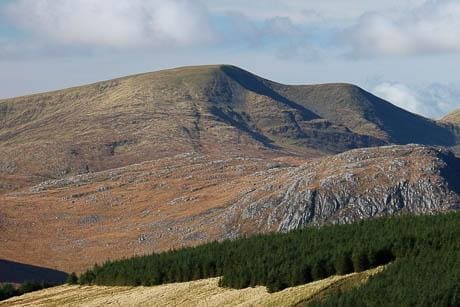 Michael led us on a fascinating journey of discovery through the Galloway Highlands. His talk was beautifully illustrated, often by his own photography, but largely with the paintings of James Faed, one of that well known tribe of landscape artists whose pictures, Michael argues, capture the Galloway landscape better than photography.
Michael explained that Galloway sits midway between Cork and Caithness and is surrounded by formerly Gaelic speaking areas, it should surprise nobody to find that Gaelic influence is widespread in the province. Although also influenced by the Brittonic speech of Strathclyde and Cumbria, and later by the Anglo-Scandinavian which would spread through the Lowlands and ultimately evolve into Scots, Gaelic was the predominant community language from around 870 AD until 1560, and lingered in some areas into the 19th century. That influence is clearly evident in place names; almost all the hill names are Gaelic, although it is possible some are Gaelicised interpretations of names that were originally Brittonic.
Michael divided his material across six identifiable geographical features: the Merrick to Shalloch-on-Minnoch range; the Dungeon of Buchan; the Rhinns of Kells; Larg Hill to Millfore; Cairnsmore of Fleet to Cairnsmore of Dee; and finally Cairnsmore to Carsphairn. His extensive references to old maps brought home to us what a very enlightening source they can be when looking into our past. He referred to those of Timothy Pont, created in the 1590s, the Blaeu Atlas of 1654, Ainslie’s 1821 map, together with other military surveys, right up to the early Ordnance Survey maps we are so used to today.
 He told of the efforts of these early cartographers to transcribe local names that doubtless sounded outlandish to them, leading to some strange and confusing examples of phonetic spelling as well as hilarious later efforts at Anglicisation as Gaelic began to retreat, probably in the 17th century. Both these maps and the passage of time have obscured the origins of many place names. One example of many Michael used was that of Ben Yellary, named Bennellury H in Blaeu, Ben Yetter by Ainslie in 1797 and Benyeller by Ainslie in 1821. This is usually interpreted as Beinn na h-Iolaire, or the ‘mountain of the eagle.’ However the absence of suitable crags for nesting has called this into question. Some believe that Beinn na h-Eileirig, or the ‘mountain of the deer-trap’ is more likely, evidenced by a nearby farm named ‘Eldrick’ as well as what is suggested by the landscape. Either way, the Gaelic origin of the name is beyond doubt.
This is a large area, bursting with history and cultural fascination, and Michael did a sterling job in presenting a vast and wide-ranging body of material in an entertaining way that could have kept his audience spellbound long beyond the allotted time. There is much more to digest, compellingly related in the book. Galloway: the Lost Province of Gaelic Scotland is available from John Dewar Publishers on www.johndewarpublishers.com