
We were proud to welcome Professor Ewen Cameron, Sir William Fraser Professor of Scottish History and Palaeography at the University of Edinburgh, as our guest lecturer at New Register House for the first of the Royal Celtic Society’s 2019/2020 lecture series on Monday 9 September.
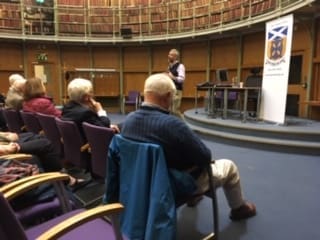 Professor Cameron, who has long specialised in the history of the Scottish Highlands took as his theme, Land Reform in Scotland: the Legacy of 1919, in which he developed themes previously addressed in his ground-breaking book, Land for the People: the British Government and the Scottish Highlands. In this, the centenary year of the Land Settlement (Scotland) Act, Professor Cameron argued that this was the single most significant piece of legislation in the history of land reform in Scotland. He explained that it had emerged from concerns about socialist politics in Scotland, and in particular about the influence of John Maclean – described by Scottish Secretary Robert Munro as “a convict on license” – and about the influence of the conflict in Ireland which had emerged during and after the First World War, to which the land question was central.
We heard that, in the years after 1880, land reform was at the core of the political agenda, throwing up many pieces of legislation beginning with the Irish Land Act of 1881, which granted security of tenure for the first time. In Scotland, the Crofters’ War and the Acts of Parliament that followed kept the issue in the forefront of political life, leading to the Small Landholders’ Act of 1911 which extended the provisions of the Crofters’ Act to the whole of Scotland, and to the setting up of the Scottish Land Court in 1912, of which the current Chairman, Lord Mingiinish, is a member of the Royal Celtic Society’s council.
The Act of 1919 gave very extensive powers to government effectively to nationalise land and landed estates of very significant extent were taken into public ownership during the 1920s, although its early promise was not ultimately fulfilled and land reform of this kind, for both political and financial reasons, ceased to be fashionable from the late ’20s. However, the establishement of a series of reformind administrations at Holyrood after 1999 has put the question very much back on the political map, amid increasing concerns that very large tracts of rural Scotland are controlled by a handful of often absentee landowners.
We are grateful to Professor Cameron for leading a stimulating and informative discussion of this very topical issue, and to Ruairidh Maciver of the BBC who recorded the lecture and subsequently interviewed Professor Cameron and our council member Hugh Dan MacLennan. These interviews were broadcast on BBC Alba the following evening, Tuesday 19 September, and can still be viewed on BBC iplayer.
We return to the New Register House for the next lecture, from Lorna Pike on Scottish historical lexicography, on Tuesday 8 October.