
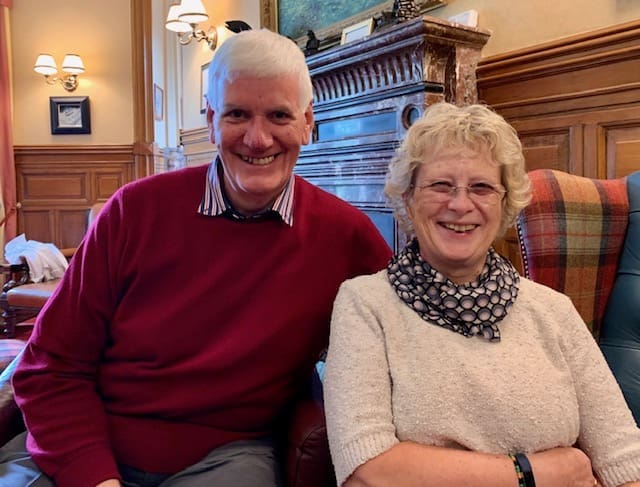
 The last of the Spring lecture series took place on Saturday 15 May when we heard from Shelagh Macpherson Noble on the life of her great grand uncle, Alexander Macpherson, a survivor of the ill-fated Burke and Wills expedition into the Australian interior in 1860.
Sandy Macpherson was born in Newtonmore in 1835, the middle child in a family of nine, born to plasterer Ranald Macpherson and his wife, Isabella Gordon. The family were Gaelic speakers, as was usual in Badenoch at that time, and the young Sandy was a shinty player in that district that is, to this day, the main centre of the sport. Although money was tight, Sandy clearly benefited from a sound education, as evidenced by his letters and the report he was later required to provide to the expedition committee. He completed his apprenticeship as a shoemaker and in 1855, following his father’s death, he departed for Australia, one of the many hopeful adventurers who responded to the gold rush in the state of Victoria.
Like many others, Sandy was disappointed by the results of his prospecting efforts and he used his expertise in leather work to establish himself as a saddler near Bendigo, where he became an enthusiastic member of the Bendigo Caledonian Society, where he continued to play shinty along with many other Highland immigrants to the colony. When he saw an advertisement for a saddler to join an expedition traversing Australia from Victoria to the Gulf of Carpentaria, Sandy was one of 20 applicants for the job, to which he was appointed on 7 September 1860. The purpose of the expedition was to explore a feasible route for an overland telegraph line across the continent from south to north, then onwards to the new telegraph line in Java, by which a connection could be secured with Europe. The distance is approximately 2000 miles, across country largely unknown the European incomers.
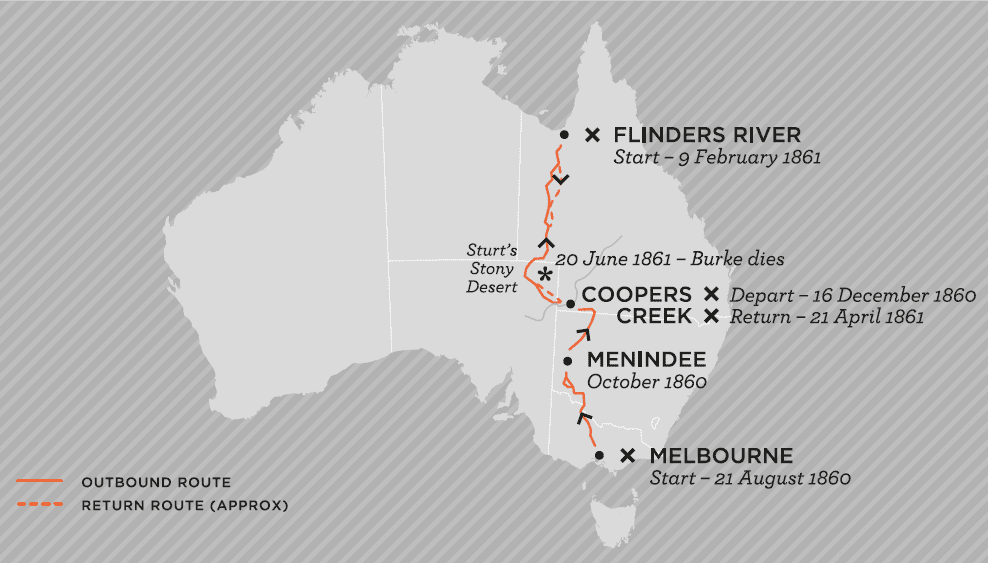 The expedition was led by Robert Burke and William Wills, neither of whom had any experience of exploration or of budgeting and planning a venture on this scale. Their record keeping was equally poor so it is difficult to be precise about how many others were involved, but best estimates indicate the total strength of the party was between 40 and 50 people, 11 of whom died. During the early days, Burke constantly argued with senior members of the expedition which resulted in several resignations of key people. Planning was wholly inadequate and it is equally clear that further problems arose due to the relatively poor funding the venture attracted, which totalled, £14,600. Of this amount £5,500 was spent importing camels from Rajasthan; camels first appeared in Australia several years earlier, but they had not been used in exploration and proved unsuitable for the task. Shoes were made for them to enable them to travel over stony ground, but due to an error, the shoes were left behind. Fodder had not been considered – it was assumed they would eat the same as the horses – but it was discovered too late that they could not live on Australian grass. The groom who had come with them from Rajasthan to manage the camels was Hindu, and could not eat the meat-based diet the expedition had planned, so he resigned. Before the venture was many days old, it was already in severe difficulty, but rather than take stock of the problem, the organisers pressed on regardless.
The journey was arduous, crossing isolated and arid desert and bush, and beset by a local population that was often hostile to the newcomers. Indeed, a rival expedition was forced to turn back following an aboriginal attack. Notwithstanding all its problems, however, Sandy’s expedition did succeed in reacing its northern objective. Tragically, however, 11 of the group, including both of the leaders, starved to death on the return journey.
 Competition was fierce to achieve the first crossing of the continent and in the past it has been fashionable to view Burke and Wills as the leaders of a heroic enterprise. That view has been now been revised in light of the haphazard approach they took to managing the enterprise. Sandy Macpherson and two others were separated from the main party (due to Burke pressing on without them), became hopelessly lost, and had to slaughter their animals for food. Sandy suffered severe malnutrition and lost seven stones in weight. They survived only because a local tribe they encountered took pity on them. They eventually found their way back to the depot camp more by luck than judgement, and by the diligent and knowledegable assistance of Dick, their aboriginal guide, without whom they were surely doomed. Sandy eventually arrived back at his saddlery on 8 March 1861, apparently none the worse for his great adventure.
Sandy remained in Australia until 1865, when he moved to Greymouth in the South Island of New Zealand, once again in search of gold. He became a prominent member of the community and died there on 23 September 1896, in the local hospital on whose committee he had served.