
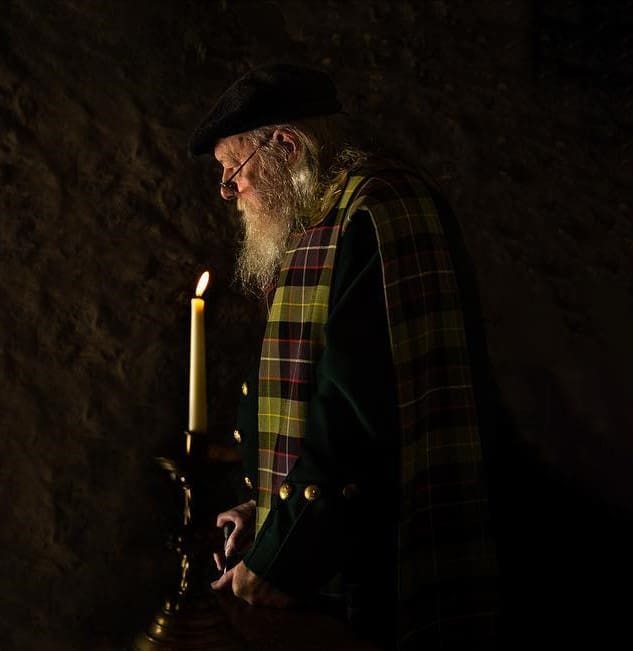
 by Stuart Morris of Balgonie and Eddergoll
The Much Honoured Raymond Morris of Balgonie & Eddergoll
4 August 1930 to 28 August 2022
My father was a longstanding member of the Royal Celtic Society, joining in the ‘60s. His interest in history went back to his youth. He was heavily influenced by the romantic view of the medieval knight and chivalry, largely through the films of Errol Flynn and his ilk. This interest delved deeper into Scottish history, the clan system and Celtic art. As a boy, he would improve his toy soldiers, then progressed to building model ships from scratch. One of his models won him a prize and is the only one that I have. This went on to him working with his hands, in adult life, in heraldry, Celtic art and the making of targes.
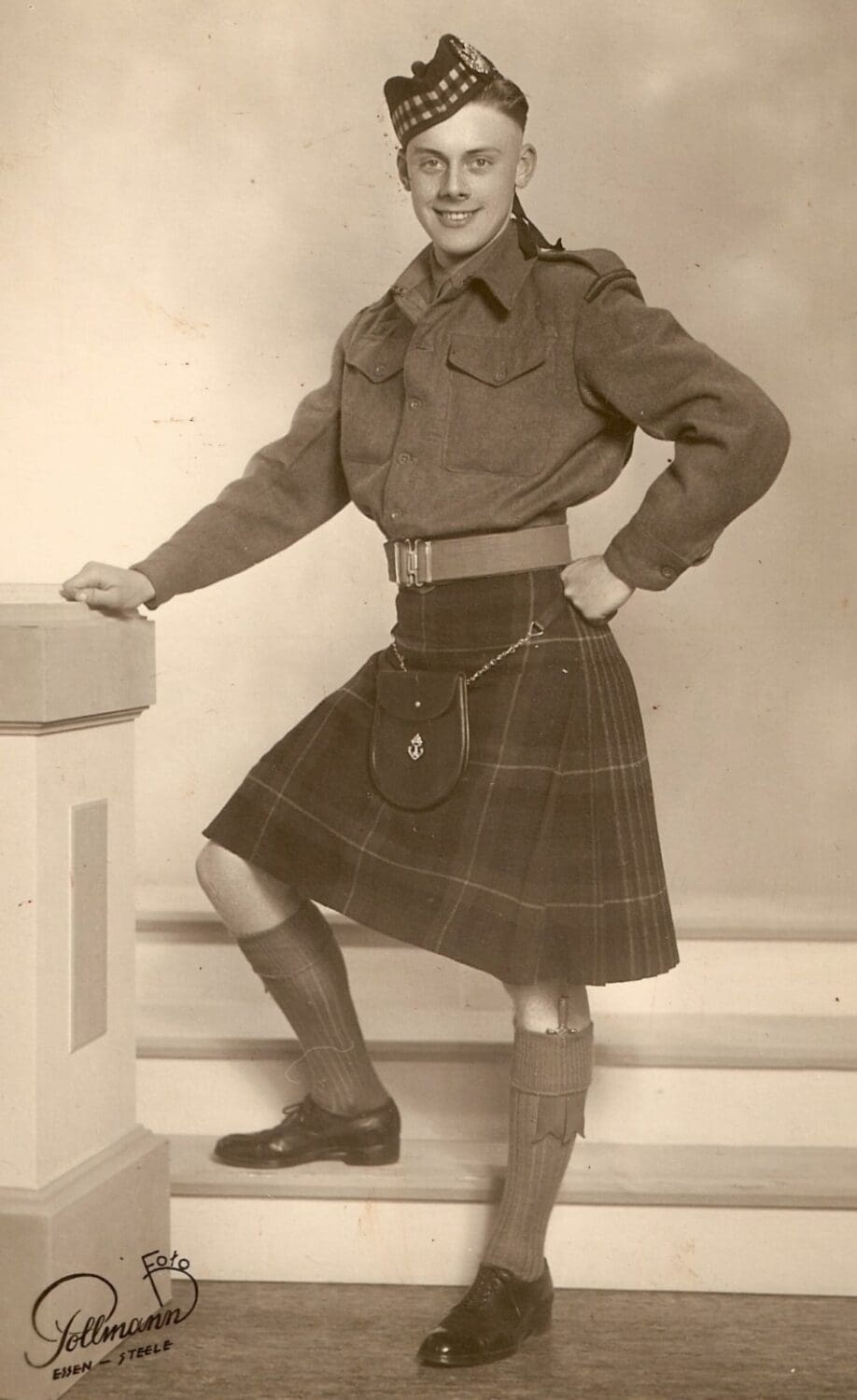 He went to Queen Mary’s Grammar School, but he was not very scholastic. However, he said that he was thankful as it gave him a good grounding for life. A couple of years above him was the actor, Frank Windsor. The one part of school that he enjoyed was the Officer Training Corps which he joined in 1942. The war was in full swing, and he did his bit by acting as a messenger for the Home Guard and ARP. Unbeknown to his parents (his father being in the ARP), he would climb over bomb sites to look for scraps, preferably from incendiary bombs, which were apparently ideal for model making. He joined the Clan Morrison Society, as a Life Member, in 1947. The society seems to have gone into mothballs in the ‘60s. It is possible that my father was the last surviving member.
He was called up for National Service in 1948, doing his basic training with the Highland Light Infantry at Fort George. He was posted to the Gordon Highlanders and sent to Germany, first Essen and then Berlin. This was the height of the Berlin Airlift, the largest humanitarian effort of the 20th century. His one lasting impression was seeing people sitting at the side of the roads chipping the cement from the bricks, so that they could be used to rebuild the city.
There was one exciting thing that happened during the run up to May Day in 1950. There was a belief that the Soviets were going to use a gathering of the Communist Youth at the Brandenburg Gate as an excuse to invade West Berlin. The Gordons were put on alert. My father’s company were stationed in a hotel near the Gate. However, the hotel was under construction and consisted of concrete walls, floors and ramps (where the steps were going to be built). The ramps were difficult to get up with army tackety boots. Thankfully May Day past without anything untoward.
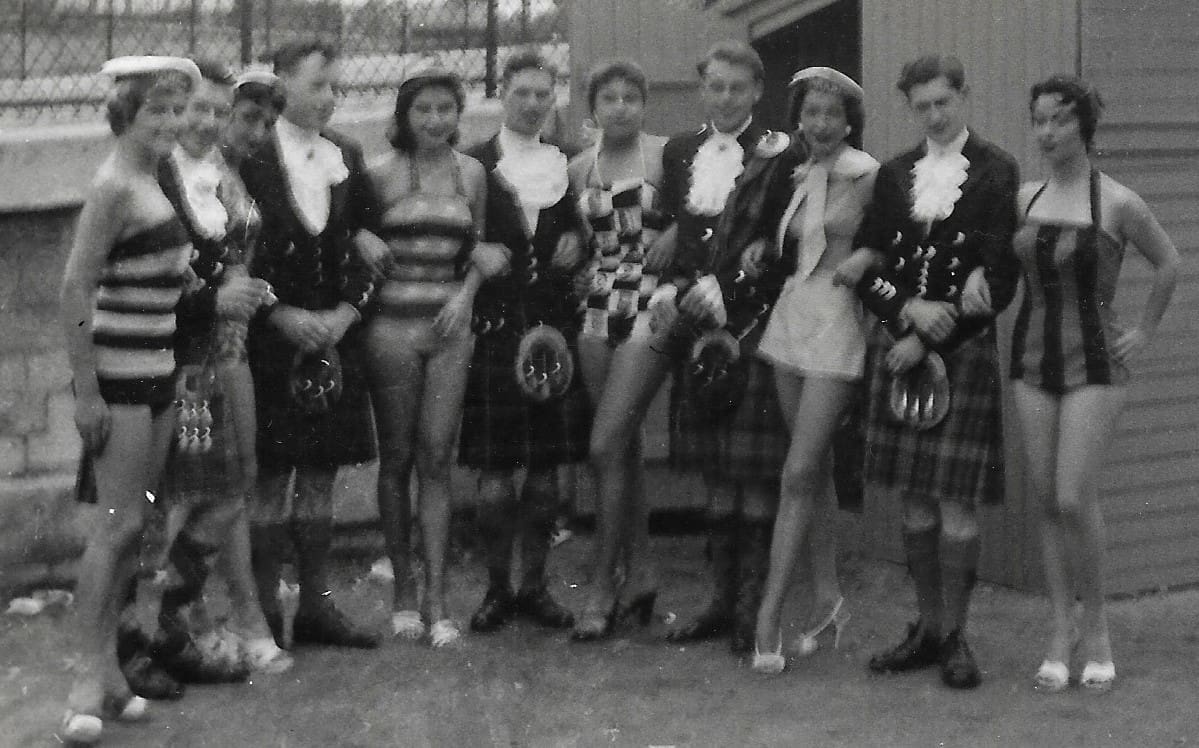
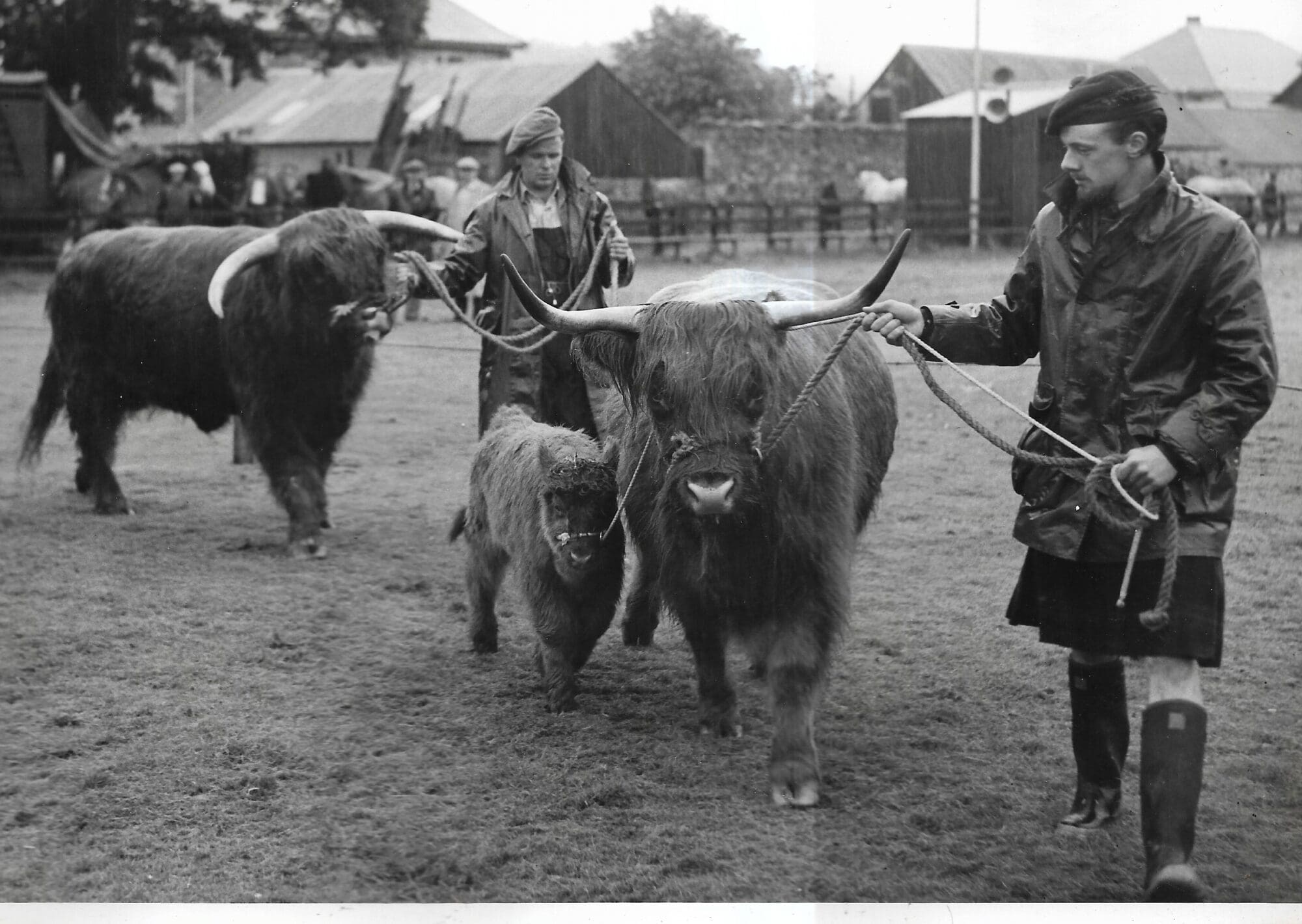 He knew that he did not want to work in an office, so most of his jobs were outdoors. After demob he went into the leather tanning industry. During this time he took silversmithing classes and made a number Highland accoutrements, some of which were hallmarked with the coronation mark for 1953. He changed direction and worked on a farm outside of Scone, where he gained his Tattie Rogueing certificate. He joined the Perth Gaelic Society and then became a member of the Inchside Dancers, touring France in 1954. He got itchy feet and moved to Tarland in Aberdeenshire to work with the MacRobert fold of Highland Cattle. The manager was the late Bill Reid VC.
My father was still not settled, so moved to Angus and became a forester for the Earl of Airlie. He would sometimes climb to the top of the then ruinous, Forter Castle, to eat his lunch. He would also work in the policies of Airlie and Cortachy Castles. The old earl loved to tinker with engines so would often be in a boiler suit. On one occasion and American family appeared in the grounds of Cortachy. They asked the boiler suited old man if the earl was around. The earl pointed to my kilt-wearing, father and said ‘that’s him.’
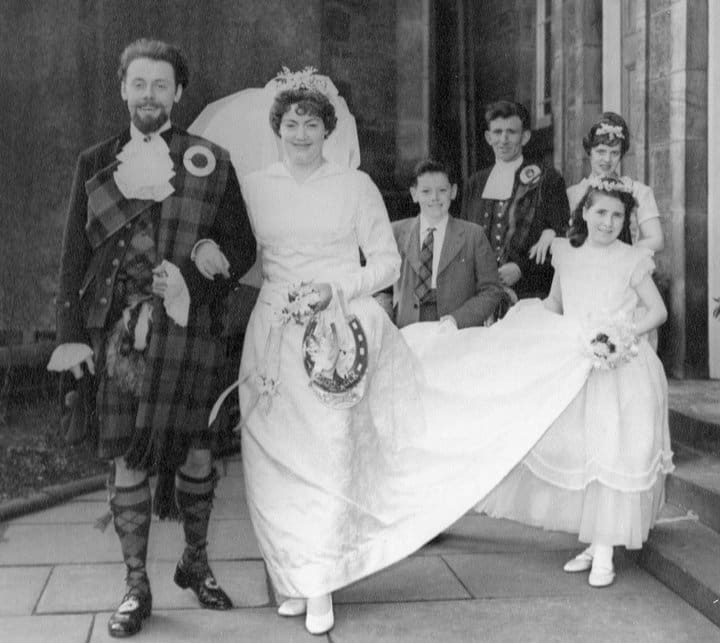 He went to study Forestry at the East of Scotland Agricultural College, part of Edinburgh University. This is where he met my mother, who was studying Horticulture (she was a rose grower.) After marriage they moved to Loch Tay, where my father was a Head Forester and where I came along. His love for old buildings saw him beginning the first of several restoration projects, by buying the Old Mill. The mill dated from 1480 and had belonged to James III. Their restoration was nominated for a Civic Trust award.
In 1969 he started to work as a leather craftsman, specialising in Celtic art and heraldry. He exhibited in Sweden, America and Austria. His work is housed in collections around the world and one of his works is in the National Leatherwork Museum.
In 1973 my father was invited to exhibit at the British Fortnight of Neiman Markus department store in Dallas, Texas. By chance he met Jimmy Logan. At this point Jimmy was the highest paid British entertainer. So, my father introduced himself to Jimmy, who in turn exclaimed ‘you exist’. Apparently, people had been going up to him and asking if he was Raymond Morris! An interesting aside is that my future mother-in-law was just along the road, as a Dallas Police Officer. It is a small world. My father was Chairman of the Kenmore and District Tourist Association. My mother was Chairman of the local SWRI and on the Perthshire committee for the Queen’s Silver Jubilee.
 The next restoration project was a Georgian Town house in Cupar. The outbuildings turned out to be a medieval merchant’s house. Although the centre of Cupar was a conservation area, our outbuildings were not included. This was very surprising as they were possibly the oldest domestic building in the town.
1985 saw the start of his final restoration project, Balgonie Castle. This has been a very slow project which I am continuing. The restoration of our chapel led to a very successful wedding business, drawing couples from over 40 countries. My father opened various galas and was asked to stand in for HRH the Princess Anne (whose mother-in-law had just died) to open the first Fife Vintage Car Rally. Local artist, Max Scotto, painted my father’s portrait, which was unveiled by Margaret Dean, Lord Lieutenant of Fife. Max later painted a posthumous portrait of my mother. My father was also a founder member of the Heraldry Society of Scotland, principal founder of the Scottish Castles Association, and founder member and Honorary Life President of the Markinch Heritage Group.
In the recent years he struggled with the effects of a lifetime of physical activity. He had a heart condition and a very rare heart murmur. During one long stay in hospital, the medical students were told to listen to his heart, because they would probably never hear this murmur again in their medical career.
Balgonie is full of my father’s heraldic and Celtic work, which includes carving fifteen doors. My father made preparations for his final journey by making his own coffin. This was painted with Celtic art, his arms and guidon and other images associated with his life.